Black: Embracing the Void and Transformation
A Chapter in Your Secret Conversation with Colours
As an artist, colours are at the core of my universe. Yet, if someone had told me when I was a young art student that colours could alter your mood, regulate your nervous state, or even facilitate healing, I would have thought they were rather mad. Nevertheless, that is precisely the story I am about to share.
Through working with colour, cultivating energetic awareness, and practising channelling, I have come to understand more deeply how colours can impact and influence our lives. Intrigued? Join me on a journey through the spectrum with a series of articles, beginning with… black.
Table of Contents
Black
Whether black is a colour depends entirely on whom you ask. In physics, black is not a colour but the absence of light. While all other colours possess specific wavelengths of visible light, black occurs when all wavelengths are absorbed, meaning none are reflected back to our eyes. From this scientific perspective, black is a void of illumination.
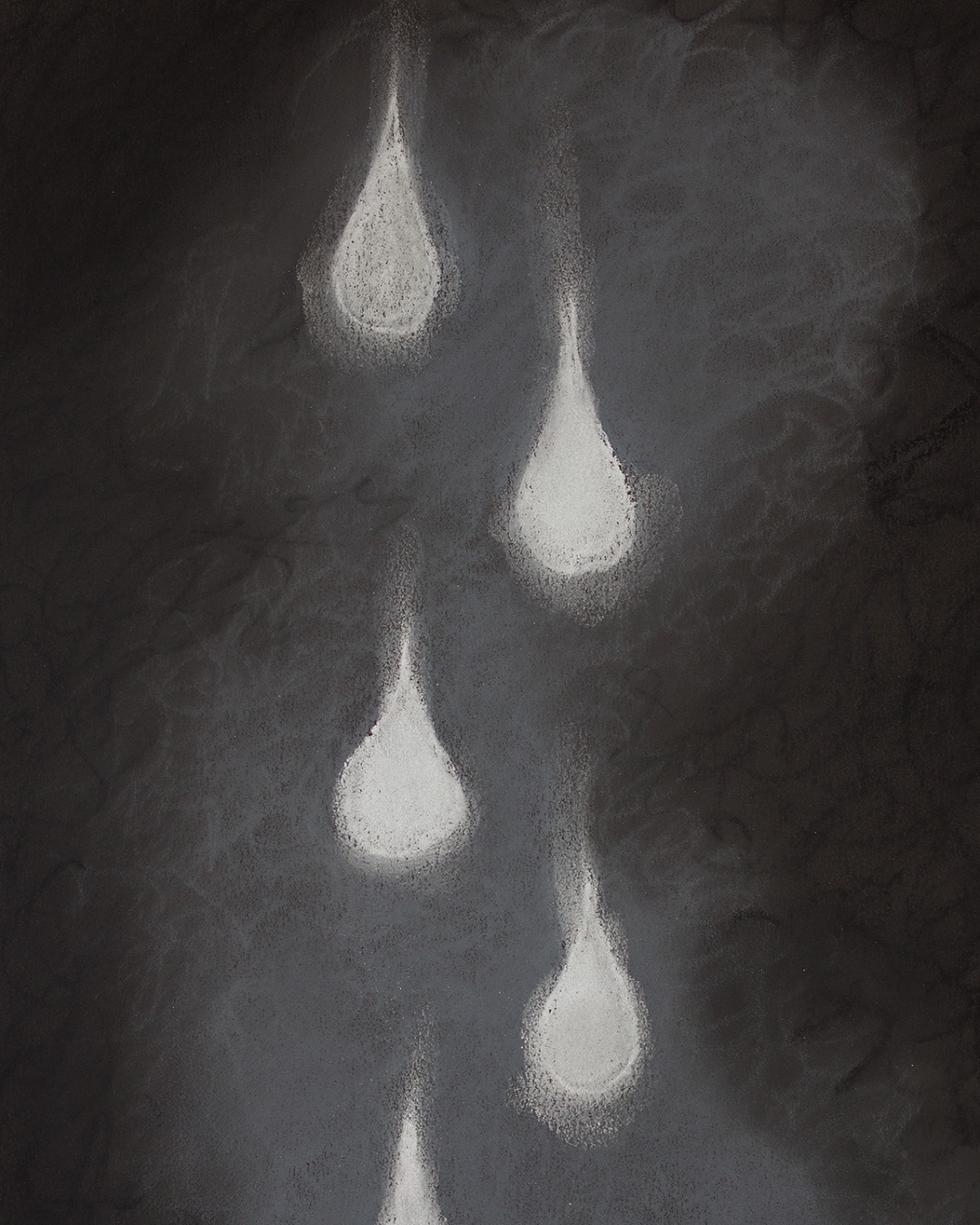
In art, however, black is unequivocally a colour. It is used to darken other hues, create shadow, and provide contrast. In my own practice, black serves as the base colour for the paper I use in pastel illustrations, as it enhances the vibrancy of the pigments. Paradoxically, through this process, I create life on paper starting from the void.
Like you, I was raised with specific social protocols and practices, therefore black holds a significance for me that is strongly imprinted by the culture in which I grew up. However, while black is often connected to death or grief in the Western world, it can symbolise maturity and masculinity in Africa; modesty, life, resurrection, and fertility in the Middle East; winter, water, impartiality, selflessness, and raw honesty in China; experience and dignity in Japan; or introspection and the closure of a cycle in some Native American tribes.
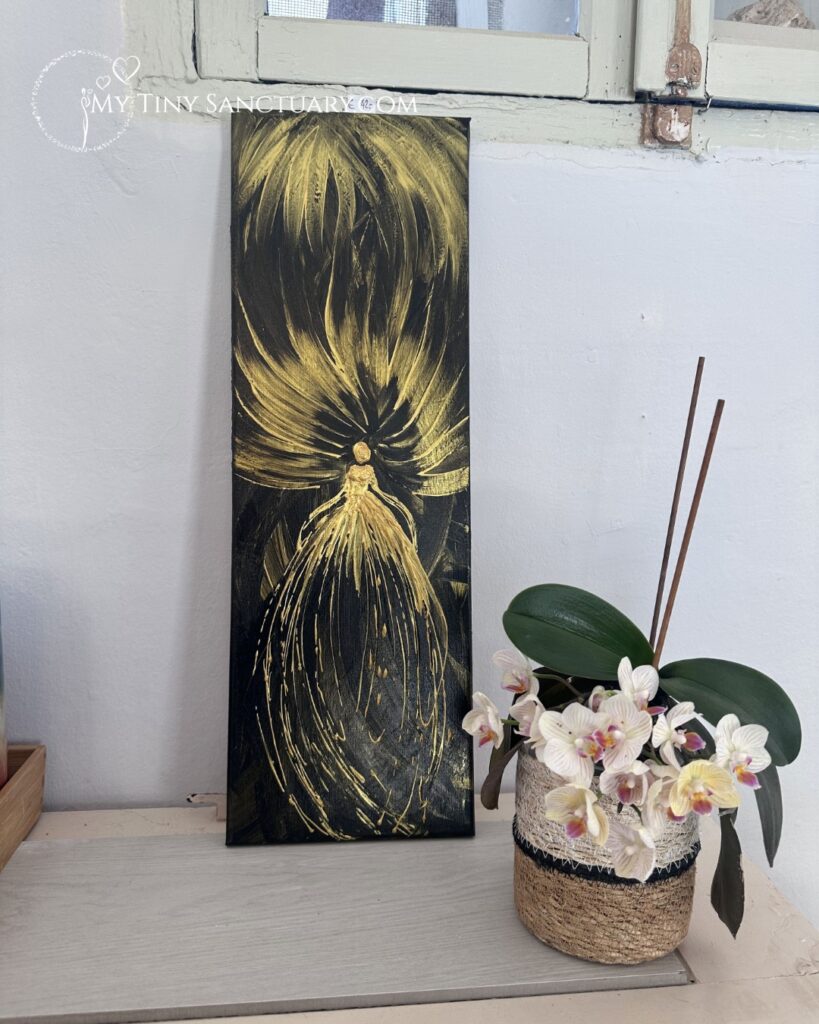
The Golden Flame: Acrylic on Canvas – A Guide Through the Void
222,00 €
Black the colour of the crysalid
The chrysalis phase of a butterfly represents the transition from one state of being to another. We can witness this physical process: from larva to chrysalis, and finally, to butterfly. Yet, in our own lives, we face many such life-changing transformations—emotional, physical, and intellectual.
As the absence of light in physics, black can easily symbolise the void before matter, a liminal state, or the feeling of stillness and a lack of tangible results. Navigating a "black phase" is rarely a fast process, as it implies a deep, internal transformation.
It is fascinating to observe how colours resonate with the subconscious and influence the choices we make regarding our attire. For instance, for several generations now, teenagers across Europe have felt drawn to wearing black. Consciously, this may be about feeling "cool" or blending in with a new tribe. However, considering that black is the colour of grief in these latitudes, a new understanding emerges. Indeed, adolescence is a major chrysalis phase. It is the moment a human moves from childhood to adulthood, experiencing massive hormonal changes and facing new expectations of responsibility, autonomy, and maturity. Yet, emotionally, they are often still children; the transition can be a painful process for many.
During this chrysalis phase, parents shift from being the centre of their child's social universe to occupying a position on the periphery. Some teenagers begin to see their parents in a different light; the once "superheroes" may temporarily become "super annoying." They will experience their first love and their first heartbreaks. They will slowly realise that the world, which once seemed full of possibility and freedom, is governed by many rules and is not as easy to navigate as it appeared.
Whether teenagers wish to become invisible or to be seen as the "cool ones," funnily enough, black becomes, for the vast majority, their go-to colour. It acts as a rite of passage, silently declaring:
"I am no longer who I used to be, even if I do not yet know who I will become."
Teenagers are not the only ones feeling called to the darkness for their transformation process. In South American shamanic traditions, particularly those of the Andes, the deepest grounding centre of the body, known as the Saphi, is connected to the dark, fertile soil of Mother Earth (Pachamama). Here, black is not the absence of life, but the rich, fertile void where seeds germinate. It is the colour of the Earth itself, reflecting its capacity to absorb heavy energy and transmute it into nourishment.
Likewise, many ancient European traditions included a retreat into a dark cave as part of a rite of passage or a transitional process for those seeking enlightenment. First, they had to meet themselves from within and face their fears; only then could they truly "know thyself." In this light, working with black is an act of trusting the Earth to hold us while we transform, much like a seed in the dark soil before it becomes a flower.
Black the colour of grief
The tradition of wearing black in Europe during periods of mourning originated in the Roman Empire. In ancient Rome, the toga virilis worn in daily life was white, but during mourning, citizens opted for the toga pulla, a dark garment representing the absence of light and life.
This custom persisted across Europe throughout the Middle Ages, initially reserved mostly for wealthy families as high-quality black dye was expensive to produce. Eventually, the tradition permeated all social classes.
By the Victorian era, the rules had become rigorous. Widows were expected to wear heavy black clothing without any jewellery for a full year following their loss. Afterwards, they could transition to softer black fabrics with white trim, and finally, introduce muted shades like grey, lavender, or mauve before returning to a normal dress code.
By the late 19th century, wearing black for grief was a social expectation throughout Europe and the Western world, symbolising solemnity, respect for the dead, and the mourner's withdrawal from the pleasures of social life.
The tradition remains active in some countries, such as Greece, extending beyond widows to all relatives. While widows traditionally wore black for life, other relatives observed specific periods, often centered around the critical 40-day window believed to be the soul's journey.
Yet, grief has many shapes and forms. Perhaps you have lost a loved one, but maybe you are feeling the loss of what you used to trust, the loss of the reality you once knew, or the future you were hoping to experience.
Grief itself is a transformative process. You mourn not only the departed but also the person you were when you were with them. You grieve the spark that person ignited in you and the parts of your own identity that were activated only in their presence.
In this context, black becomes an external statement of having lost a piece of yourself… until you find it again. While it is natural to become stuck in the nostalgia of a person, that is not the ultimate purpose of life. As painful as it is to say goodbye, it is vital to find a way through the grief so that you can rediscover yourself. Perhaps you can look at what this person ignited within you and find a way to kindle that flame in their memory and celebration. Then, with time, you may meet new people who are happy to help you keep that spark alive, allowing you to find joy in it once more.
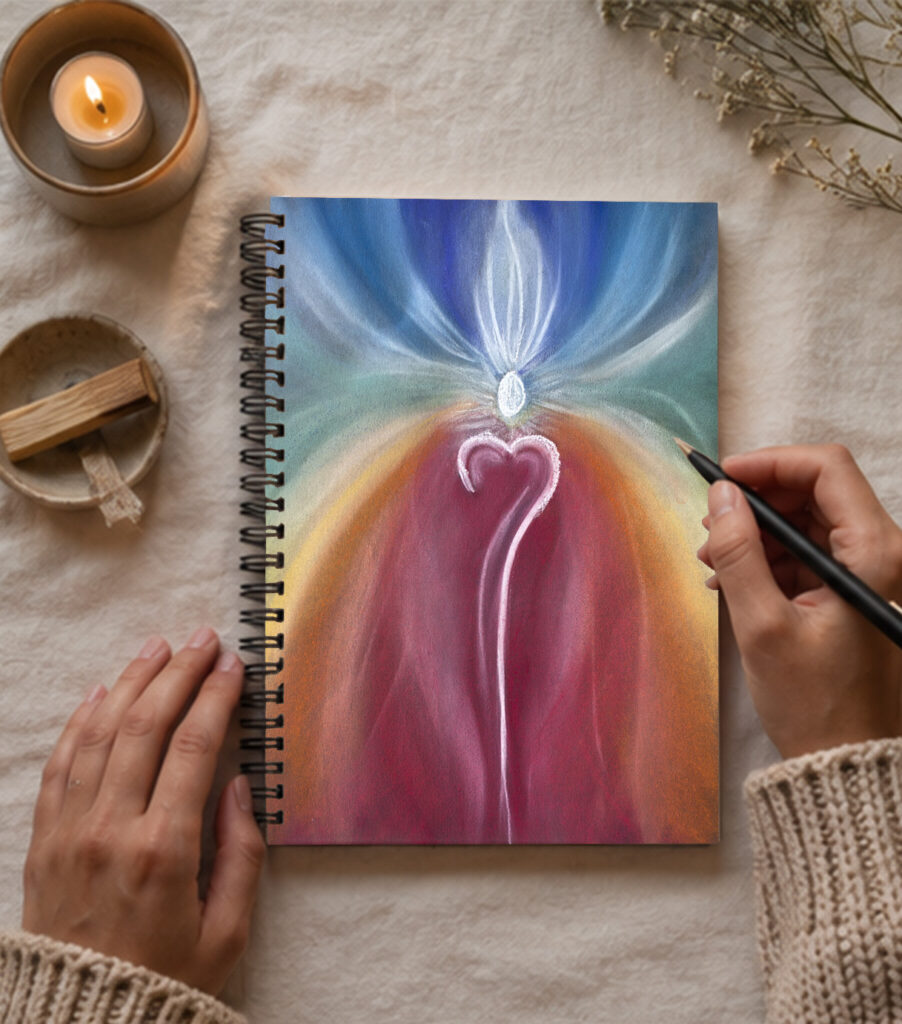
OM Chakra Notebook – Joy Compass Journal | A5 Notebooks for Meditation and Alignment
22,54 €
A Collective Story in Black
The inspiration for this article comes straight from my atelier and shop. If you follow my work, you may already understand that I am a sensitive person—an empath—who feels the energies around me strongly. Working in a village that lives to the rhythm of the tourist season, I spend about five months each year immersed in the energies of people from all over the globe.
This year, 2026, for the first time in decades, I felt a compelling urge to reach for a tube of black paint and black beads. I was surprised; for decades, black has only been available to me in paper form when using my pastels. I even had to purchase paint I did not previously own. So, why this calling?
Naturally, I first wondered if this impulse originated within me. Was it because I was turning fifty, or perhaps due to the onset of menopause? Yet, deep down, I knew it was not. So, I looked around, opened my ears, and paid closer attention to the commonalities in what people expressed while chatting in the shop. There it was: grief.
From every continent, clients who lingered to speak shared their disillusionment with politics, the choices and beliefs of their home countries, and the system in general. They spoke of feeling fooled or manipulated, powerless against wars they do not want, held hostage by rising prices, and fundamentally uncomfortable with the society they currently inhabit.
Other clients spoke of new experiences, describing how their lives and everything they once believed in had gone down the drain almost overnight. These individuals were more positive, led by curiosity, yet still lost amidst the newness presenting itself. They were searching for inspiration, clarity, and… light once again.
It is no surprise, then, that black is trying to emerge in my creative process. A chapter of our civilisation is closing, and another is emerging. No one knows exactly what it will be; some fear the worst, while others hope for the best. Yet, all are swimming in a soup of uncertainty, and it is uncomfortable.
It took me a couple of months to pinpoint this "grief frequency." As a sensitive person, I initially thought I was slipping into a slight depression, yet something felt amiss. What this grief frequency was activating in me was a mirror. It reflected what I needed and wanted to nurture in my own life. Once I identified that, it became easier to differentiate what was mine and what belonged to others. It became easier to be present for some people while setting boundaries with others. Just because the doors of my shop are open from 10 am to 10 pm in the summer does not imply I must serve everyone’s emotional needs.
So, I would like to hand that mirror to you, so that you too can observe: what is Black telling you about yourself?

My Tiny Black Book | Your Emotional Dump Journal
28,09 €
Your Black Story
Now, it is your turn to explore what the colour black represents for you. Its vibration might signal grief or transformation, but it can signify many other things as well.
For instance, when I used to wear black, it was to hide my curves, my differences, and my quirks. Later, I wore it because I was told it was elegant, the safest choice to avoid a dress-code faux pas ("when in doubt, wear the black dress"). I am sure that, like me, you have had many definitions of your own "black".
So, why not explore them?
Take a piece of paper, or even better, your journal, and begin by writing down what the colour black means to you. Then, divide a page into two columns. In the first column, copy the statements below that resonate with you:
Black is the colour I prefer wearing when:
-
- I want to hide, be unnoticed, or be forgotten.
- I want to stand out, feel elegant, or elevate my allure.
- I want to look slimmer or conceal parts of my body.
- I want to feel cosy.
- I want to feel safe.
- I feel like withdrawing, creating distance between myself and others, or needing my own bubble.
- I feel sad.
- I feel down or have the blues.
- I have lost someone, or a part of myself.
- I want to express my anger or my non-alignment with the world around me.
Next, add your own reasons for wearing black to this list. Then, in the second column of your journal, write down the emotions you typically experience in each of these situations. For example, if you wear black to hide, you might be feeling shame, discomfort, fear of humiliation, bullying, or criticism. Perhaps there is a whole range of other emotions you are experiencing.
Your Growth Through Black
What is particularly interesting to notice is that some emotions can be contradictory. You might feel both shame and safety simultaneously.
This duality informs you about how you wish to feel versus what is currently preventing you from feeling that way, regardless of the colour you wear.
If you feel inclined to experiment with colour and self-perception, this exercise can offer a roadmap for the aspects of yourself you wish to transform.
Let me be clear: I am not suggesting you go on a diet if you use black to hide your curves. Rather, I am inviting you to consider how you can first embrace and love yourself as you are, so that you feel safe and confident regardless of the colour you are wearing. That is the self-healing practice for this context.
Then, when you feel drawn to black, pause and ask yourself:
- Am I letting go of something? If so, can I practice self-compassion during this process?
- Am I sensing the energy around me and needing to protect myself? If so, I must remember to practise setting healthy boundaries today.
- Am I…? Then… (Complete the sentence with your own intuition).
Based on your own self-exploration with black, you can begin to identify your emotional, physical, and energetic needs. From there, you can start creating solutions for yourself by setting clear intentions and recalibrating your behaviours.
Remember, the chrysalis is dark not to trap the butterfly, but to protect the transformation happening within. By understanding your own relationship with black, you stop fearing the void and start trusting the process. You realise that sometimes, we must step into the dark to find the light we are truly meant to become.
Practices to Navigate the Void
Gentle ways to sit with the darkness without being consumed by it.
When you are in the chrysalis phase, the instinct is often to fight the darkness or rush toward the light. But Black asks you to do something harder: to stay. To trust that the void is not a tomb, but a womb.
The following practices are designed to help you find calm within the stillness and release what no longer serves you.
Connecting With the Message(s) from the Black Frequency
The Black Meditation is a journey toward what needs more light. We all have blind spots and we can all feel confused or lost at times when facing a situation, experiencing a relationship or simply living our life and experiencing a world in constant evolution, turmoils and healings.
This meditation was born out of the experience shared in this article so that you too can connect to what the black is trying to tell you about yourself.
If the word black has negative conotation in your vocabulary, be reassured that it is not black magic, nor it is meant to experience something you are not ready for.
A guided meditation is a journey where your subconscious, your emotions and your intuition have a space to express themselves.
It will not replace professional support if you are in a deep depression, exitensial crisis or major shift in your life. However, it can support your ongoing process and help you connect to your safe space and inner messages (the one you offer yourself from a wisdom place rather than judgment or fears).
Releasing Emotions with Your "Little Black Book"
My Tiny Black Book | Your Emotional Dump Journal
28,09 €
What if you had a journal dedicated only to an emotional dump? A space where you write without the intent to solve, analyse, or fix, but with the strong, singular intent to let it out?
- The Tool: Instead of a precious journal, use a simple notepad. This distinction is important: a journal is for keeping; a notepad is for releasing.
- The Process: When the grief, anger, or heaviness feels too big to hold, take your pen and write it all down. Do not worry about grammar, logic, or making sense. Let the ink carry the weight of what is brewing inside you. Fill the page until your hand slows down and your breath deepens.
- The Ritual of Release: Once you have recognised what is inside, you do not need to keep it.
- Tear it out: Rip the page from the pad.
- Shred it: Cut or tear the paper into tiny pieces to symbolically take distance from the negative emotions. Watch them become confetti rather than a heavy story.
- Burn it (Safely): If you feel called, burn the paper in a safe container (like a fireproof bowl or sink). Watch the smoke carry the energy up and out, leaving only ash behind.
This act tells your subconscious: "I have felt this. I have honoured it. And now, I let it go."
From Void to Spark
These practices are not about fixing the grief; they are about making space for it. They are about learning to breathe in the dark until the darkness no longer feels like an enemy, but like a cocoon.
But remember, the chrysalis is not the end of the story. When you have sat in your Tiny Black Box long enough, when the shredding of old pains has cleared some space, you might notice a tiny, warm spark appearing in the darkness. That is the first whisper of Gold. It is the promise that alchemy is beginning. It is the frequency of truth waiting to pierce the fog.
When you feel ready to follow that spark, to alchemise your pain into power, read the next chapter: [Gold: Alchemising Pain into Power].
This article is part of the series 'The Secret Conversation You're Having With Colour':
Explore Other Colours
Discover the quiet dialogue between you and the colours you choose every day. This journey invites you to listen to your subconscious, understand your true needs, and use your personal palette to validate your feelings, boost confidence, and feel deeply supported.